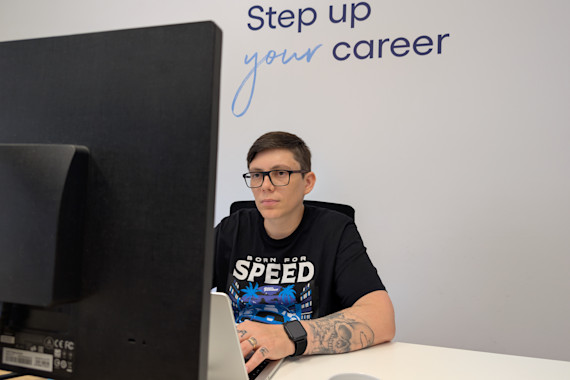

From technical support to the world of Business Intelligence, Leonardo Maia’s journey is an example of how the right curiosity can turn data into decisions with real impact. Currently a BI Consultant at Dellent, he works with a client in the telecommunications sector and shares with us, in this interview, his perspective on the day-to-day of the role, the most common challenges, and what it takes to grow in this constantly evolving field.
We talk about databases, dashboards, and strategic decisions, but also about essential skills, adapting to the cloud, and the growing role of artificial intelligence in the work of those who, every day, transform information into real business value.
To start, tell us a bit about your background. How did you get into the world of BI?
It’s interesting because I started in Support, like most people who enter the IT field. When I began university, my intention was to work with the web, web programming, web design, that kind of thing. However, halfway through my studies I started working as a systems analyst, and that’s when I had my first contact with databases.
At that early stage, the topic wasn’t widely discussed; it was the year 2000 and BI wasn’t very widespread. Although it had existed since around 1975 or 1977, in Fortaleza, where I lived in Brazil, it didn’t have much presence.
Over time, after finishing university, I started working as a systems analyst, doing some programming in Java and ASP. Even so, I never felt like a strong programmer. I didn’t fully identify with the programming side. On the other hand, I always enjoyed the database programming component and felt naturally drawn to SQL.
Around 2007/2008, I worked at a company where BI already existed, and I began to look at that area differently. Still, at that point, I hadn’t yet made the transition.
Between 2010 and 2012, an opportunity arose to work with data processing. It wasn’t exactly BI yet, but I started handling data for internal auditing. I extracted data from the database and processed it so auditors could carry out internal audits. That’s when I realized I really enjoyed working with data.
After that company, I moved to another where I was responsible for implementing BI. I began studying and deepening my knowledge, especially in visualization tools, the part everyone sees, the frontend component that tends to catch the end user’s attention. When I understood the potential of this area, I took the proposal to my manager and explained that it could be a good opportunity for the company. Even so, it took some time for him to convince senior management, who weren’t very familiar with the topic.
It was around 2015 that I effectively started working with BI. Part of my day was still dedicated to systems analysis, with reports more focused on the database component, and the other part was dedicated directly to BI. That was the year I truly committed to the BI path.
I attended training and began implementing solutions. The team already had experience with databases, but modeling is different: you move from relational modeling to dimensional modeling. Because of that, we had to create a database. I wouldn’t yet call it a data warehouse (in the sense of a cross-functional model for the entire company), because it was an initial project, but rather a data mart, that is, a part of a data warehouse oriented toward a specific area.
A data mart was created for a specific area, education, with the goal of analyzing student performance. We wanted to understand, for example, whether a student who performed well in Portuguese struggled with Mathematics, that kind of correlation. We also wanted to understand why students from certain classes achieved better results than others, whether the teacher made a difference, among other factors.
It was a very interesting experience. In the initial phase, a consultancy was hired to provide support, since no one had experience in the area. After the consultancy left, I became responsible for BI. I went on to develop all the company’s dashboards and reports across various areas such as education, finance, and human resources.
What were the biggest milestones or transitions in your career so far?
The first major milestone happened when I left support and moved into development as a systems analyst. Until then, I worked mainly with hardware, and from that point on, I started working with software. That was the first major milestone in my career, around 2004/2005.
The second major milestone came when I started working with data processing. That was in 2015, although I went back and forth a few times, since I also worked as a systems auditor. From that point onward, I dedicated myself exclusively to working with data and BI.
The third major milestone was moving countries in 2023, which represented a significant transition in the way I work.
What fascinates you most about the world of Business Intelligence?
There isn’t really a routine and there’s always something new to do. That’s what makes it challenging, because situations often arise that we’ve never dealt with before. There’s always something new to learn, whether in terms of technologies or approaches.
In IT in general, new tools and solutions are constantly emerging, which forces us to keep learning and evolving.
Besides that, when we manage to deliver a report or dashboard that truly makes a difference for the company, it’s extremely rewarding. Our work can genuinely change the direction of an organization.
For example, when I worked in auditing, I also handled data processing and dashboards. There was a moment when the team carried out an audit, and as we started structuring the data in dashboards and processing it, we identified financial discrepancies. It had a significant impact, because it involved a loss the company wasn’t aware of. The situation was acknowledged and, in the end, the company was able to recover the amount.
Is there any stage of the process, from data collection to visualization, that you particularly enjoy?
I enjoy the visualization part the most. I like data processing, but I prefer visualization. I had training in design when I was younger, so I really enjoy finishing things, creating something with impact.
What types of projects or sectors motivate you the most?
Honestly, I don’t have a specific preference. I’ve worked in finance, human resources, education, and currently in call centers. There isn’t a favorite area, but working with finance is interesting because it’s the most common one and the easiest area in which to demonstrate results.
The impact is more visible for the company, because financial results tend to be more immediate and measurable. Organizations value this area greatly, especially when they realize they are saving money or need to change strategy. That impact is very significant.
What type of client or sector are you currently working with?
I’m currently working on a telecommunications project focused on customer service, specifically outbound and inbound operations, answered calls, and other indicators.
The most relevant information includes the number of calls answered and made, callbacks, average handling time, and response time. Since the company has a very strong customer service operation, it can measure these times and understand whether or not the customer is satisfied.
In the end, the customer themselves rate whether they were well served, which helps assess agent performance. Through the dashboards we develop, the company can identify what is working well, what needs improvement, and from there optimize the service provided.
How is the team organized and what are your day-to-day responsibilities?
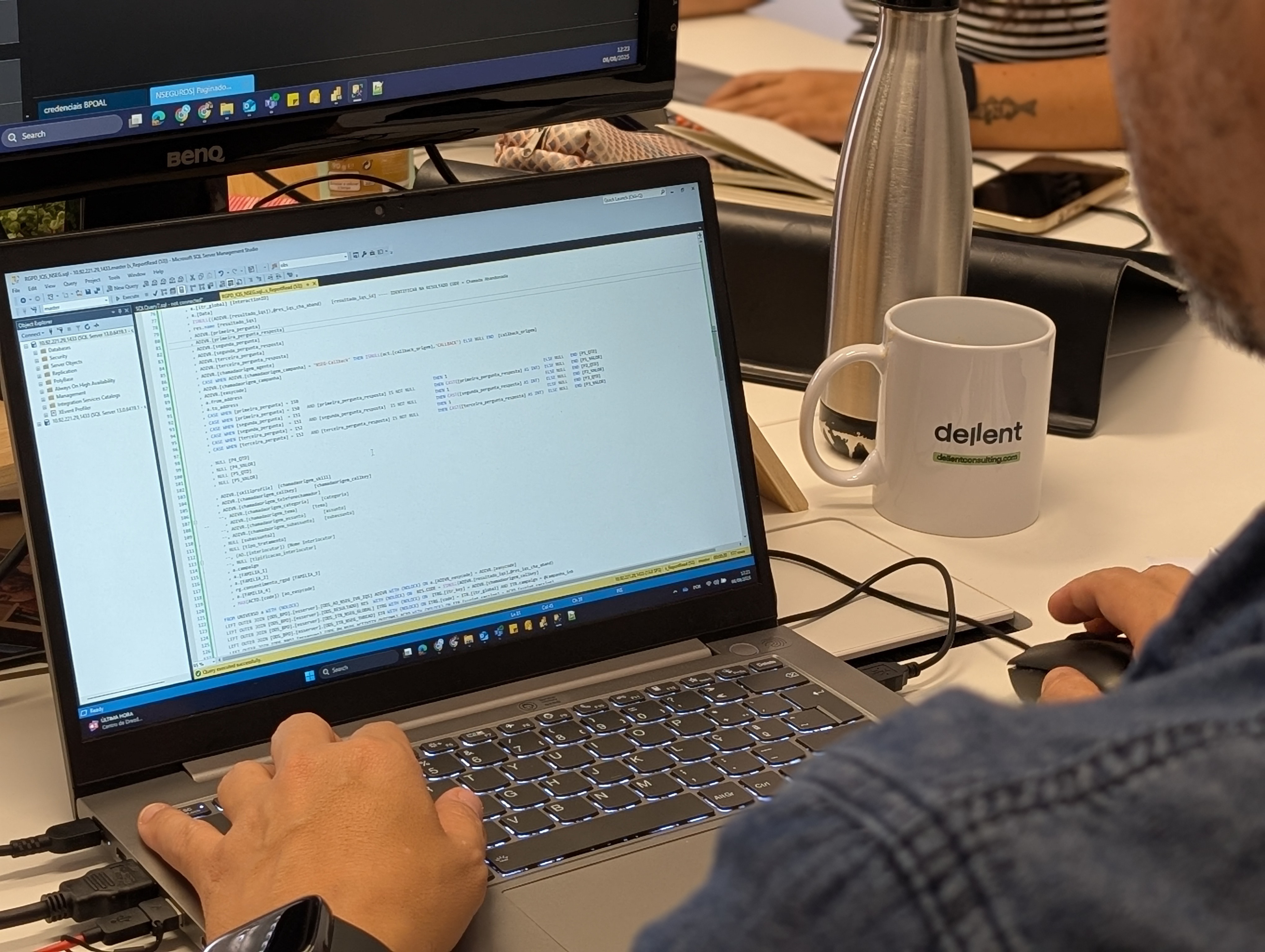
The team is quite large and divided into several areas. Our specific team consists of four people: one lead and three analysts. One analyst focuses more on database administration, another mainly works in ETL, and I have a mixed role, combining frontend and ETL. Our tech lead is more focused on the frontend.
My role involves exactly that combination of ETL and frontend work. We work on demand, and on a given day I might have several ETLs to develop, perform data processing, and then integrate that information into dashboards.
Sometimes new clients also come in, including external clients, and we need to respond to them. We develop dashboards for clients and account managers, always focused on phone contacts, email, or SMS. When a new client comes in, everything needs to be created from scratch, adapting the base model that already exists.
Which BI tools or technologies do you use in this project (e.g., Power BI, Tableau, SQL, Azure, etc.)?
We use pure SQL to store and process the data. We use Power BI Report Services to create printable reports and Power BI for developing dashboards.
What direct impact do you see on the client’s business?
From the end-customer’s perspective, it is possible to measure everything related to service speed, understand whether processes are working correctly, identify areas for improvement, and assess which agents perform best and which are less productive.
Based on this set of metrics, the company can make informed decisions about what to do or not do next.
For those who are not familiar with it, how would you explain the role of a BI consultant?
Our role is to take the data that exists within a company, regardless of the area, and make it readable so that decision-makers can act in an informed and assertive way about the business. It’s a process similar to taking code and turning it into understandable text.
It involves, for example, removing test records that should not be included in the analysis. Databases tend to accumulate a lot of “noise,” and this cleaning work is essential to ensure the information being analyzed is reliable.
In your opinion, what are the key skills a good BI professional should have?
Having strong knowledge of databases and SQL is fundamental. It is also important to master a visualization tool, understand dimensional modeling, and have a solid grasp of the business and the domain you are working in.
That’s why experience across different areas is very valuable, as it allows you to develop a broader perspective and understand different realities.
We often joke that managers don’t always know exactly what they want, but they know very well what they don’t want. If I deliver something that doesn’t meet their expectations, they will realize it immediately. That’s why a BI consultant needs to anticipate what the manager truly needs, even when it isn’t completely clear from the start.
What types of technical and human challenges do you usually face?
The most important challenge is understanding what the manager really wants, because often they think they want something, but the required information doesn’t even exist in the way they imagine. In those cases, we have to find alternatives to deliver something as close as possible to what was requested.
It’s common to encounter databases with a lot of “noise” or with incorrect modeling that cannot be changed because they are legacy systems. In these scenarios, some “juggling” is required, creating well-crafted DAX measures and calculated columns, tasks that demand a lot of work and are difficult to change later.
There is also the human component: it’s not always easy to understand, from the stakeholder’s perspective, what they truly want, which often requires several meetings. One of the most frustrating situations is when we deliver work that ends up not being used. I’ve had cases where I spent weeks developing something, delivered an excellent result, and still saw that work go unused.
What advice would you give to someone who is just starting out or wants to enter the BI field?
Knowing SQL is essential, it’s something you really must learn. Today, BI is a very broad field and can be divided into several areas, but SQL remains the foundation.
For those who want to work with data processing, mastering ETL tools is crucial. Many companies are currently migrating to the cloud, and while it’s not mandatory, having knowledge of cloud-based tools is clearly a strong advantage.
Another skill I consider important and one I personally still need to keep developing is Python, especially for those working with data processing or as data engineers.
Finally, it’s necessary to master a data visualization tool. In my case, I work with Power BI, but there are other tools on the market, such as Qlik Sense or Tableau.
How do you see the evolution of the BI role with the advance of Artificial Intelligence and automation?
I believe that BI analysts will increasingly need to deepen their knowledge of data processing, even to achieve more solid career progression. In the beginning, the BI analyst did almost everything; later, roles became more specialized, but now, with the rise of artificial intelligence, it will once again be necessary to know a bit of everything.
Many tasks will no longer be performed manually, which makes it increasingly important to have professionals managing these processes. In this context, mastering data processing becomes essential.
I recently read that we are already talking about different profiles, such as ETL analyst, data engineer, and BI engineer, a professional who combines engineering skills with business knowledge, dashboards, and data visualization.
Is there any tool you’ve discovered recently that has made your work much easier?
In my current role I don’t use this technology yet, but from what I’ve seen, many companies are already using Microsoft Fabric. I believe that many organizations will migrate to this tool over the next few years.
What message would you like to leave for readers who are considering a career in BI?
Study SQL thoroughly, it remains the foundation. Spark is also important for data processing. It’s equally relevant to start following new tools, as the trend clearly points toward widespread migration to the cloud. In that context, knowledge of Microsoft Fabric, Azure, AWS, or Google Cloud is a strong asset.
--
Found this area your cup of tea? 🫖 Explore all our available BI and Data Engineer projects here!